- 微调决策树:避开 80% 团队踩过的“盲目微调”深坑。
- LoRA / QLoRA 数学直觉与显存账本:为什么一块 24GB 消费级显卡也能微调 14B~32B 模型?
- SFT → DPO 偏好对齐:从“学会听话”到“学会审美品位与安全克制”。
- Eval-Driven Development(评测驱动开发):没有黄金评测集,微调就是盲人摸象。
1. 先踩刹车:什么时候才真的需要微调? / Stop First: When Should You Actually Fine-Tune?
微调(Fine-Tuning)意味着你要承担数据清洗、训练基础设施、版本回滚、底座模型升级后重训的长期运维债。在启动训练之前,请严格按顺序过一遍这三道漏斗:
- Prompt + Few-Shot 试过没有? 很多时候换一个更强的模型 + 写清 XML 规范 + 给 3 个例子,半小时就搞定了。
- 如果是缺“业务事实知识”,上 RAG!(见 L2-01)微调记不住实时更新的数据。
- 真正适合微调的 4 个黄金场景:
- 极致的延迟与成本压缩(蒸馏):用旗舰大模型生成 10,000 条高质量样本,微调一个 7B/8B 小模型,在特定垂直任务(如意图路由、SQL 生成、信息抽取)上达到旗舰 95% 效果,成本直降 20 倍、延迟降 5 倍。
- 高度专有的输出格式或行业黑话:如特定医疗编码规范、金融合规报文、小众领域 DSL 代码。
- 严苛隐私 / 离线内网部署:数据不可出网,必须在私有化开源小模型上压榨极致性能。
- 定制人设与行为对齐:改变拒答边界、对话语气或特定交互协议。
Fine-tuning creates ongoing engineering debt (data curation, GPU runs, regression testing, re-training whenever a better base model drops). Follow this ladder first:
- Exhaust Prompting + Few-Shot before touching weights.
- Use RAG for facts (L2-01)—never fine-tune to memorize volatile knowledge.
- Fine-tune when you have one of these 4 high-ROI goals:
- Distillation for speed & cost: Distill a frontier model’s outputs into a 7B/8B specialist—often matching ~95% task quality at 10–20× lower cost and much lower latency.
- Strict domain syntax / proprietary DSLs that few-shot prompting still fumbles.
- Air-gapped / privacy-critical deployments running open-weight models on-prem.
- Custom behavioral alignment: Specific tone, persona, or refusal boundaries.
2. LoRA 与 QLoRA:用 1% 的参数撬动百亿模型 / LoRA & QLoRA: Moving Mountains with 1% Parameters
传统全量微调(Full Fine-Tuning)要更新模型全部权重。一个 7B 模型光权重(FP16)占 14GB,加上梯度(14GB)和 AdamW 优化器状态(FP32 主权重 + 一阶/二阶动量 ≈ 84GB),训练就需要 ~112GB+ 显存!
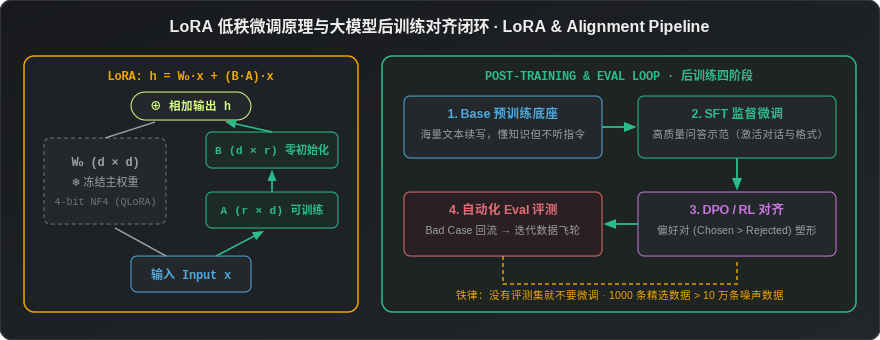
微软提出的 LoRA(Low-Rank Adaptation,低秩适配) 带来了一个优雅洞察:微调过程中权重的变化量 ΔW 其实具有极低的“内在秩(Intrinsic Rank)”——不需要改写整张 4096 × 4096(1677 万参数)的大矩阵,只需冻结原权重 W₀,在旁边并联两个极瘦的小矩阵 A (r × d) 和 B (d × r)(例如秩 r = 16):
LoRA 前向公式:
h = W₀·x + (α / r) · (B · A) · x
- 参数量从
4096 × 4096 = 16.7M暴降到2 × 4096 × 16 = 0.13M(不到 0.8%!) - 矩阵
B用 全 0 初始化,确保训练第 0 步时B·A = 0,完全不破坏预训练底座的原有能力。 - 推理部署时可以把
W_merged = W₀ + (α/r)·B·A直接合并回原权重,实现零额外推理延迟!
而 QLoRA 更进一步:把冻结的底座 W₀ 用 4-bit NormalFloat (NF4) 量化塞进显存,反量化计算时只更新 BF16 的 LoRA 旁路,再配合 Paged Optimizers,单卡 24GB 就能轻松微调 14B+ 模型!
Full Fine-Tuning updates every weight—meaning a 7B model needs ~14GB for FP16 weights, ~14GB for gradients, and ~84GB for AdamW optimizer states (>112GB VRAM before activations!).
LoRA (Low-Rank Adaptation) exploits the fact that weight updates ΔW during adaptation live in a low-rank subspace. Freeze W₀ and attach two skinny trainable matrices A (r × d) and B (d × r) (e.g., r = 16):
LoRA Formula:
h = W₀·x + (α / r) · (B · A) · x
- Trainable parameters drop by >99%, drastically cutting optimizer VRAM.
Bis initialized to zeros so step 0 starts identically to the pretrained model.- At inference time, merge
B·Adirectly intoW₀for zero added latency.
QLoRA pushes this further by quantizing the frozen base weights W₀ to 4-bit NF4 while training LoRA adapters in BF16—unlocking 14B–32B fine-tuning on a single 24GB–48GB GPU.
| 训练方式 Method | 7B 模型显存需求 Est. VRAM | 70B 模型显存需求 Est. VRAM | 适用定位 Positioning |
|---|---|---|---|
| Full Fine-Tuning (BF16 + AdamW) | ~112 GB(2×80G A100) | ~1.1 TB(多机 16×80G) | 注入海量新领域语料 / 持续预训练 |
| LoRA (BF16 Base, r=16) | ~18 ~ 24 GB(单卡 3090/4090) | ~160 GB(2~4×80G) | 90% 工程场景首选,效果接近全量 |
| QLoRA (4-bit NF4 Base, r=16) | ~8 ~ 12 GB(笔记本/单卡 T4) | ~46 GB(单卡 A6000 / A100) | 预算受限快速验证与个人开发者微调 |
3. 数据黄金法则与 DPO 偏好对齐 / Data Quality & DPO Alignment
数据质量 > 数据数量(LIMA 启示)
Meta 的经典论文 LIMA 证明:1,000 条人工精挑细选、逻辑严谨、覆盖多样的 SFT 数据,效果吊打 10 万条爬虫拼凑的脏数据。微调数据里的每一条幻觉、错误格式、啰嗦客套话,都会被模型忠实地放大并固化进权重里。
SFT 之后为什么还要对齐(RLHF vs DPO)?
SFT 教模型“模仿好答案”,但它没教模型“避开差答案”——模型可能会把好答案和似是而非的幻觉赋予相近的概率。
- 传统 PPO RLHF:需要同时维护 4 个大模型(Actor、Reference、Reward Model、Critic),显存爆炸且超参极难调稳。
- DPO(Direct Preference Optimization,直接偏好优化):用精妙的数学推导把 Reward Model 消掉了!只需要准备三元组数据集
(Prompt, Chosen 优质回答, Rejected 劣质回答),直接用一个简洁的分类交叉熵损失,拉高 Chosen 概率、压低 Rejected 概率,同时用 Reference 模型约束 KL 散度防止模型“学崩”!
Data Quality Beats Volume (The LIMA Principle)
As demonstrated by Meta’s LIMA study, 1,000 meticulously curated, diverse SFT examples consistently outperform 100,000 noisy scraped examples. Every flaw in your training set gets baked permanently into the model’s weights.
Why Alignment (DPO) After SFT?
SFT teaches the model what good answers look like, but not how to actively suppress plausible-looking bad answers.
- Classic PPO RLHF requires juggling 4 models simultaneously (Actor, Reference, Reward, Critic)—fragile and VRAM-hungry.
- DPO (Direct Preference Optimization) algebraically eliminates the separate Reward Model: given
(prompt, chosen, rejected)triplets, a clean closed-form loss directly boosts the log-probability margin ofchosenoverrejectedrelative to a frozen reference model.
使用 peft + trl 启动 QLoRA 微调的核心配置片段 / Practical QLoRA Setup (peft)
1 | from peft import LoraConfig, get_peft_model |
4. 评测闭环:没有 Eval,千万别上线 / Eval-Driven Fine-Tuning
微调最怕一种隐形灾难——灾难性遗忘(Catastrophic Forgetting):你在客服话术上把模型训得很乖,结果它原本的代码、逻辑和指令遵循能力退化了一半!
上线前必须跑通的三层 Eval 护城河:
- 确定性单测(Deterministic Checks):JSON 合法率、SQL 语法可执行率、代码单元测试通过率(客观 0/1)。
- LLM-as-a-Judge(成对盲测):用更强旗舰模型对“微调前 vs 微调后”的输出做 A/B 盲评(注意交换顺序消除位置偏置),给出明确 Rubric 细则打分。
- 通用能力回归集:保留 100~200 条通用推理、安全拒答与边界样本,确认新模型在专精的同时没有变“偏科傻瓜”。
The silent killer of fine-tuning is Catastrophic Forgetting: your model masters your target format while silently losing general reasoning or instruction following.
Always guard releases with a 3-tier Eval Suite:
- Deterministic Verifiers: Schema validation, regex/JSON parse rate, SQL execution, and unit tests.
- Pairwise LLM-as-a-Judge: Blind A/B scoring of base vs. fine-tuned outputs using a stronger judge model and explicit rubrics (swap A/B order to cancel position bias).
- General Regression Canary: 100–200 held-out general reasoning and safety prompts to catch capability regressions early.
5. 权威延伸阅读 / Further Reading
- 📄 LoRA Paper: LoRA: Low-Rank Adaptation of Large Language Models (Hu et al.)
- 📄 QLoRA Paper: QLoRA: Efficient Finetuning of Quantized LLMs (Dettmers et al.)
- 📄 DPO Paper: Direct Preference Optimization: Your Language Model is Secretly a Reward Model (Rafailov et al.)
- 🛠️ Open-Source Toolchain: LLaMA-Factory & Unsloth — 业界最受欢迎的开源高效微调框架。