- 为什么 RNN 被彻底淘汰? 理解并行计算与长距离依赖的根本瓶颈。
- Q / K / V(Query, Key, Value)的直觉本质,以及
÷ √d_k与因果掩码(Causal Mask)的数学意义。 - 现代 LLM 对 2017 原版 Transformer 的 4 大进化:Pre-RMSNorm、RoPE 旋转位置编码、SwiGLU、以及 MoE(混合专家)。
- 逐行读懂 45 行纯 PyTorch 实现的 Multi-Head Causal Self-Attention。
1. 为什么 Transformer 横扫了 RNN? / Why Transformers Replaced RNNs
2017 年之前,处理序列文本的主流架构是 RNN / LSTM。它的工作方式像一条单行传送带:读完第 1 个词更新隐藏状态 h₁,再读第 2 个词更新 h₂……一直传到第 10,000 个词。
这带来两个致命硬伤:
- 无法并行训练:算
h₁₀₀必须死等h₉₉算完,上万张 GPU 并行算力根本吃不满。 - 信息压缩瓶颈:前面几千字的历史全被塞进一个固定维度的向量里,越远的信息忘得越惨。
Google 2017 年的传奇论文 《Attention Is All You Need》 彻底抛弃了循环传递,提出 Self-Attention(自注意力):让序列里的任意两个 Token 直接握手通信(路径长度为 1),并且整句所有位置可以做成一次大矩阵乘法,把 GPU 算力瞬间拉满!
Before 2017, sequence modeling relied on RNNs / LSTMs, which processed tokens strictly one-by-one (h₁ → h₂ → ... → h_T). This caused two fatal bottlenecks:
- Sequential training bottleneck: Computing step
thad to wait fort-1, starving massively parallel GPUs. - Information compression decay: Thousands of prior tokens had to squeeze through a single fixed-size hidden state.
Attention Is All You Need (Vaswani et al., 2017) eliminated recurrence altogether. Self-Attention connects every pair of tokens directly in O(1) path length using dense matrix multiplications that saturate modern GPU Tensor Cores.
2. Q、K、V 到底是什么?用“图书馆检索”一秒讲透 / Intuition Behind Q, K, and V
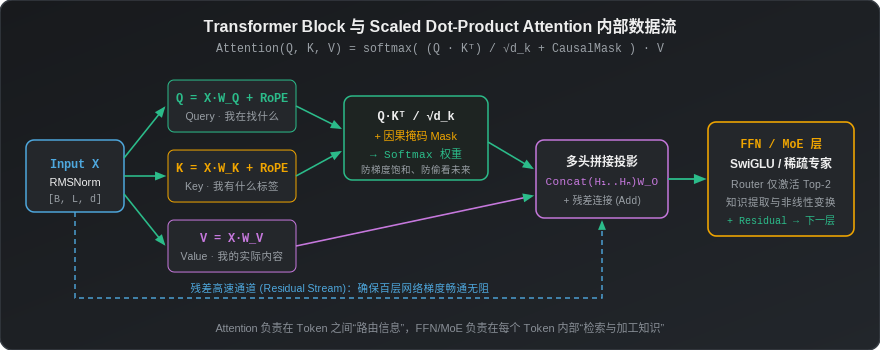
看到公式 Attention(Q, K, V) = softmax((Q · Kᵀ) / √d_k) · V 时,初学者总被 Q / K / V 三个字母唬住。其实它就是一个可微分的软哈希表(Soft Dictionary Lookup):
假设句子是:“那只猫没有过马路,因为它太累了。” 当模型处理到“它”这个词时:
- Query (
Q,查询向量) = “它”发出的提问:“我是一个代词,前面哪个名词是我的主语?” - Key (
K,索引标签) = 句子里每个词亮出的名片:“猫”的名片写着 “我是动物、主语、单数”,“马路”的名片写着 “我是地点名词”。 - 点积匹配 (
Q · Kᵀ) = 计算“它”的提问和每个词名片的契合度——于是“它”和“猫”的点积得分飙升,和“马路”的得分很低。 - 缩放 (
÷ √d_k) = 如果向量维度d_k很大(如 128),点积方差会变大导致 Softmax 输出极端趋近0或1,反向传播梯度消失;除以√d_k正好把方差拉回1! - Value (
V,实际内容) = 每个词携带的真正语义载荷。最后按 Softmax 权重把各词的V加权求和,“它”的新向量就自然融合了“猫”的语义!
什么是 Multi-Head(多头注意力)?
就是同时开 32 个或 64 个独立的“注意力小分队”:1 号头专门追踪代词指代,2 号头专门匹配左右括号,3 号头专门关注主谓宾语法,最后把所有头的结果拼起来投影合并!
The formula Attention(Q, K, V) = softmax((Q · Kᵀ) / √d_k) · V looks intimidating, yet it is simply a differentiable soft dictionary lookup.
Consider: “The cat didn’t cross the street because it was too tired.” When processing “it”:
- Query (
Q): What “it” is looking for (“Which prior noun am I referring to?”). - Key (
K): Each token’s searchable label (“cat” = animate noun/subject; “street” = location). - Dot Product (
Q · Kᵀ): Measures compatibility—“it” scores high with “cat” and low with “street”. - Scaling (
÷ √d_k): Prevents large dot-product magnitudes from pushingsoftmaxinto flat, vanishing-gradient regions by normalizing variance back to~1. - Value (
V): The actual semantic payload retrieved via weighted average, enriching “it” with “cat”‘s meaning.
Multi-Head Attention runs H attention heads in parallel—one head tracks coreference, another matches code brackets, another tracks syntax—and concatenates their insights.
3. 45 行纯 PyTorch 手写 Multi-Head Causal Self-Attention / Minimal PyTorch Implementation
1 | import math |
上面代码中显式构造 [B, H, T, T] 的 scores 矩阵会消耗 O(T²) 显存——当上下文拉到 128K 时直接 OOM。实际生产中调用 F.scaled_dot_product_attention(..., is_causal=True) 会自动触发 FlashAttention,利用 GPU 片上 SRAM 分块计算(Tiling),把显存从 O(T²) 降到 O(T) 且速度提升 2~4 倍!
4. 2017 原版 vs 2026 现代前沿 LLM 架构演进 / How Modern LLMs Evolved Beyond 2017
今天的 Llama / Qwen / DeepSeek / Claude / Gemini 等前沿大模型虽然仍流淌着 Transformer 血脉,但几乎都完成了四次关键“基因进化”:
Modern frontier LLMs still inherit the Transformer core, but four architectural upgrades have become universal defaults:
| 组件 Component | 2017 原版 Transformer | 现代前沿 LLM 标准 | 核心收益 Why It Matters |
|---|---|---|---|
| 归一化位置与方式 | Post-LayerNorm | Pre-RMSNorm | 省去均值计算更快,百层深网训练梯度极稳 |
| 位置编码 Position | 绝对正弦波 (Sinusoidal) | RoPE(旋转位置编码) | 把相对距离编码成向量旋转角度,极易外推到超长上下文(128K~1M) |
| 前馈网络 FFN | ReLU 两层全连接 | SwiGLU + MoE(稀疏混合专家) | MoE 拥有万亿总参数,但每个 Token 仅激活 Top-2 专家(如 30B),大脑更大、推理更便宜 |
| 注意力头共享 | MHA(每个 Q 配独立 K/V) | GQA / MLA(分组/潜在注意力) | 大幅压缩推理期 KV Cache 显存(详见究极篇 L4-01) |
5. 权威延伸阅读 / Further Reading
- 📄 Original Paper: Attention Is All You Need (Vaswani et al., 2017)
- 🎥 3Blue1Brown: Attention in Transformers, Visually Explained — 视觉直觉封神之作。
- 💻 Andrej Karpathy: nanoGPT & Let’s Build GPT from Scratch — 仅 300 行代码的极简 GPT 实现。
- 📄 RoPE Paper: RoFormer: Enhanced Transformer with Rotary Position Embedding (Su et al.) — 苏剑林提出的旋转位置编码奠基论文。