- 硬件第一性原理:为什么 Decode 阶段一块价值数万美元的顶级 GPU 算力利用率不到 5%?理解 Memory-Bandwidth-Bound(显存带宽墙)。
- 亲手算出 KV Cache 显存账本,秒懂 GQA 与 DeepSeek MLA 为何能把长上下文成本打下来一个数量级。
- 四大推理引擎杀手锏:PagedAttention、Continuous Batching、AWQ/FP8 量化、以及严格数学无损的 Speculative Decoding(投机解码)。
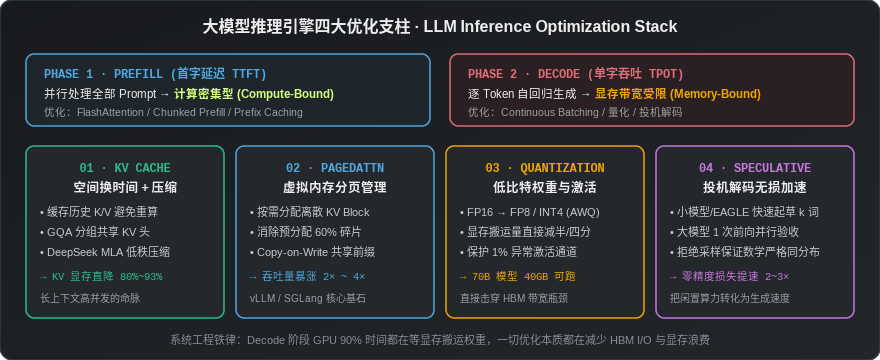
1. 硬件真相:Prefill 与 Decode 是两种截然不同的“物种” / The Hardware Truth: Prefill vs. Decode
当你向大模型发出一个请求,GPU 内部其实经历了两个物理特性完全相反的阶段:
- Prefill(预填充阶段,决定首字延迟 TTFT):
模型一次性并行读取你输入的全部 Prompt(例如 4,096 个 Token),做大规模的矩阵 × 矩阵乘法(GEMM)。此时 GPU 的 Tensor Core 满负荷运转,属于 Compute-Bound(计算受限)。 - Decode(解码生成阶段,决定吐字速度 TPOT):
模型一个字一个字地自回归吐出回答。每吐 1 个 Token,GPU 都要把整整几十 GB 的模型权重从 HBM 显存搬进片上缓存算一次矩阵 × 向量乘法(GEMV),算完只产出区区 1 个新词!- 算力(FLOPs)闲得发慌,90%+ 的时间全花在等 HBM 显存搬运数据上!这就是大名鼎鼎的 Memory-Bandwidth-Bound(显存带宽墙)。
一个算术秒懂极限速度:假设 70B FP16 模型重
140 GB,单卡 HBM 带宽3.35 TB/s。哪怕计算耗时为 0,单请求理论吐字上限也只有3350 / 140 ≈ 24 tokens/s!因此,一切推理优化的本质只有两条路:① 减少每次搬运的字节数(量化/剪枝/MoE);② 一次搬运多算几个 Token(Continuous Batching / 投机解码)。
Every LLM request goes through two physically opposite regimes on a GPU:
- Prefill (governs TTFT — Time To First Token): Processes all prompt tokens in parallel via dense matrix-matrix multiplications (GEMM). Tensor Cores stay saturated → Compute-Bound.
- Decode (governs TPOT — Time Per Output Token): Generates one token at a time via matrix-vector multiplications (GEMV). For every single token, the GPU must stream tens of gigabytes of weights from HBM—leaving compute units >90% idle → Memory-Bandwidth-Bound.
Back-of-the-envelope physics: A 70B FP16 model weighs
140 GB. On a3.35 TB/sHBM GPU, even with zero compute time, single-stream speed caps out at3350 / 140 ≈ 24 tokens/s. Every optimization therefore either shrinks bytes moved (quantization, MoE) or amortizes weight reads over more tokens (batching, speculative decoding).
2. KV Cache 与显存账本:GQA 和 MLA 如何救命? / KV Cache Math: GQA & MLA
生成第 t 个 Token 时,Attention 需要用到前面 1 ~ t-1 所有 Token 的 Key 和 Value 向量。如果不缓存,每吐一个词都要把前文重算一遍(复杂度 O(T²))。因此推理引擎会把历史 K, V 缓存在显存里——这就是 KV Cache。
KV Cache 到底有多吃显存?直接套公式算:
KV Cache 字节数 = 2 (K和V) × 层数 L × KV头数 n_kv × 单头维度 d_h × 序列长度 S × 并发数 B × 精度字节数 (FP16=2)
以经典 70B 模型(80 层、隐藏维 8192)为例,如果用传统 MHA(64 个独立 KV 头),单条 32K 上下文请求的 KV Cache 就要吃掉惊人的 80 GB——连一张 A100 都塞不下 1 个用户!
现代架构的三大破局方案:
- GQA(Grouped-Query Attention,分组查询注意力):让每 8 个 Query 头共享 1 组 KV 头(Llama-3 / Qwen 标配),KV 显存直接暴降 8 倍!
- MLA(Multi-Head Latent Attention,多头潜在注意力):DeepSeek-V2/V3 提出的神来之笔——不直接缓存庞大的 K 和 V,而是把它们低秩压缩成一个极小的联合潜向量
c_KV存入显存,计算时再通过矩阵吸收技巧动态还原,将 KV Cache 压缩 90% ~ 93% 且不掉点! - Prefix Caching(前缀缓存 / RadixAttention):相同 System Prompt 或同一份长文档的多轮对话直接复用已算好的 KV Cache,首字延迟直降 5~10 倍。
To avoid recomputing historical Keys and Values at every decode step, inference engines cache them in VRAM (KV Cache):
KV Bytes = 2 × n_layers × n_kv_heads × d_head × seq_len × batch_size × bytes_per_elem
With classic Multi-Head Attention (MHA), a single 32K-token session on a 70B model would consume ~80 GB of KV Cache alone. Modern architectures slash this via:
- GQA (Grouped-Query Attention): Multiple query heads share one KV head → 4×–8× smaller KV Cache.
- MLA (Multi-Head Latent Attention, DeepSeek): Projects K and V into a compact low-rank latent vector
c_KVcached in VRAM → 90%+ KV Cache reduction with minimal quality loss. - Prefix Caching / RadixAttention: Reuses precomputed KV blocks for shared system prompts or multi-turn histories across requests.
3. PagedAttention 与 Continuous Batching:vLLM 的核心秘密 / PagedAttention & Continuous Batching
即便压缩了 KV Cache,早期推理框架仍会浪费 60% ~ 80% 的显存——因为你不知道用户最终会生成 50 字还是 4,096 字,只能提前按最大长度预留一大块连续显存,导致严重的内/外部内存碎片。
UC Berkeley 团队在 vLLM 中借用了操作系统 50 年前的经典智慧——虚拟内存分页(Virtual Memory Paging),提出 PagedAttention:
- 把每个请求的 KV Cache 切分成固定大小的小页块(例如每 Block 存 16 个 Token),物理上可以离散地塞在显存任意空位里,用一张极小的 Block Table 维护逻辑顺序。
- 显存利用率瞬间从 ~30% 飙升至 >96%,还天然支持 Copy-on-Write(多路采样共享同一个 Prompt 块)!
再配合 Continuous Batching(迭代级连续批处理):不用傻等整个 Batch 里最慢的那个长回复结束,只要 Batch 里任意一个请求吐出 <EOS> 结束符,下一个迭代(几十毫秒后)立刻把排队的新请求插进去,系统总吞吐量直接翻 2× ~ 4×!
Early serving engines pre-allocated contiguous VRAM up to max_seq_len per request, wasting 60%–80% of memory to fragmentation.
vLLM’s PagedAttention borrows OS virtual memory paging: it splits each request’s KV Cache into fixed-size blocks (e.g., 16 tokens/block) stored non-contiguously in VRAM and tracked via a lightweight block table—pushing memory utilization above 96% and enabling Copy-on-Write prefix sharing.
Paired with Continuous (Iteration-Level) Batching—injecting new waiting requests the very instant any active sequence emits <EOS>—serving throughput jumps 2×–4×.
4. 量化(Quantization)与投机解码(Speculative Decoding) / Quantization & Speculative Decoding
量化:把“砖头”变轻,直接突破显存带宽墙
Decode 阶段既然卡在搬运权重,把权重从 FP16(16-bit) 压到 FP8(8-bit) 甚至 INT4(4-bit),显存占用和搬运时间就分别减半、四分!
- FP8(W8A8):Hopper / Blackwell 架构原生硬件指令支持,几乎零精度损失,当前云端生产集群首选。
- AWQ(Activation-Aware Weight Quantization, W4A16):核心洞见是权重里只有 ~1% 的关键通道(Salient Weights) 对激活值影响巨大——只要根据校准激活分布对这 1% 通道做缩放保护,就能在 4-bit 下几乎无损运行,让 70B 模型塞进单张 48GB 显卡!
投机解码(Speculative Decoding):免费把闲置算力变成 2~3× 速度
Decode 时 GPU 算 1 个 Token 和并行校验 5 个 Token 花的时间几乎一模一样(都是搬一次权重)!投机解码巧妙利用了这一反直觉物理特性:
- 起草(Draft):用一个极小极快的草稿模型(或 EAGLE 轻量预测头)一口气连猜
K = 5个草稿 Token。 - 并行验收(Verify):把这 5 个草稿一次性打包交给大模型,仅用 1 次前向推理同时算出大模型在每个位置的真实概率。
- 拒绝采样(Rejection Sampling):逐一核对草稿,蒙对的全部直接采纳(一次吐出 3~5 个字!),第一个没蒙对的位置按残差分布重新采样修正。
最惊艳的是:数学上严格证明,投机解码输出的概率分布与纯大模型逐字生成 100% 等价——真正做到“零智商折损、速度翻倍”!
Quantization: Moving Fewer Bytes Across HBM
Shrinking weights from FP16 to FP8 (native on Hopper/Blackwell GPUs, virtually lossless) or 4-bit AWQ (which identifies and protects the ~1% most activation-salient weight channels) directly multiplies memory-bound decode speed while cutting GPU count in half or quarters.
Speculative Decoding: 2–3× Lossless Speedup
Because verifying K candidate tokens in parallel costs almost the same HBM read as generating 1 token:
- A tiny Draft model (or lightweight EAGLE head) rapidly proposes
Knext tokens. - The large Target model scores all
Ktokens in one parallel forward pass. - Modified rejection sampling accepts the longest matching prefix and corrects the first mismatch—mathematically guaranteed to preserve the exact output distribution of the target model with zero quality degradation!
动手精算:Python 快速估算任意模型的权重与 KV Cache 显存 / Quick Python VRAM Estimator
1 | def estimate_llm_vram_gb( |
5. 权威延伸阅读 / Further Reading
- 📄 vLLM / PagedAttention: Efficient Memory Management for Large Language Model Serving (Kwon et al.)
- 📄 Speculative Decoding: Fast Inference from Transformers via Speculative Decoding (Leviathan et al., Google)
- 📄 DeepSeek MLA: DeepSeek-V2: A Strong, Economical, and Efficient Mixture-of-Experts Language Model
- 🛠️ Serving Engines: vLLM · SGLang — 当今最核心的两大开源推理引擎。