- 第二条 Scaling Law:为什么让模型多“想” 30 秒,有时比把参数量扩大 10 倍更划算?
- RLVR(基于可验证奖励的强化学习)与 GRPO:揭秘推理模型如何不靠人类手写思维链,自己“顿悟”出验证、回溯与分治策略。
- 多智能体(Multi-Agent)系统架构法则:如何避免“多 Agent 互相吹捧死循环”,用 Orchestrator-Worker + 确定性沙箱 Verifier 构建工业级自主工程系统。
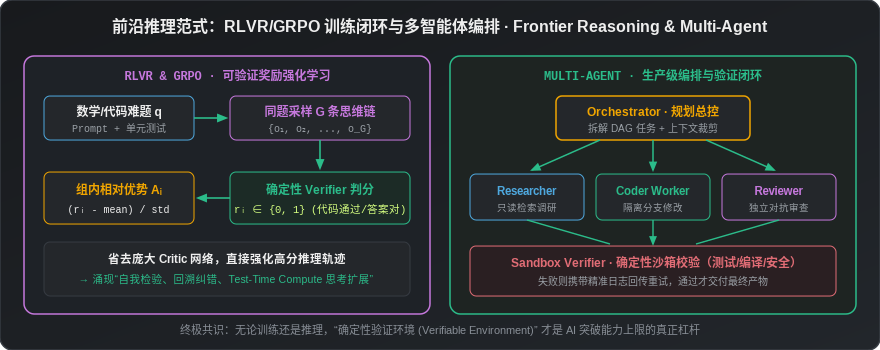
1. 范式跃迁:从 Pre-Training Scaling 到 Test-Time Compute / The Shift to Test-Time Compute
2020–2024 年,AI 行业的唯一主旋律是 Pre-Training Scaling Law(预训练扩展律):给更多卡、喂更多网页语料、把模型训得更大。但人类互联网高质量公开文本终有天花板。
于是,行业开启了第二条增长曲线——Test-Time Compute Scaling(测试时计算扩展),用心理学家丹尼尔·卡尼曼的术语来理解:
- System 1(快思考 / 传统对话模型):无论题目多难,看到问题立刻凭直觉脱口而出(每个输出 Token 花费固定算力)。
- System 2(慢思考 / 推理模型):面对数学证明、复杂代码架构、多步系统排障时,先在内部展开成千上万字的深度推演、提出假设、自我反驳、尝试另一条路径,用额外的推理时间换取指数级跃升的解题上限!
For years, AI progress followed one axis: Pre-Training Scaling (more GPUs, more tokens, larger weights). As high-quality public human text approached saturation, frontier labs unlocked a second scaling axis: Test-Time Compute Scaling.
Using Daniel Kahneman’s mental model:
- System 1 (Fast Intuition): Standard LLMs blurt out answers immediately with fixed compute per token.
- System 2 (Deliberate Reasoning): Reasoning models spend extra compute at inference time—exploring hypotheses, catching dead ends, backtracking, and verifying intermediate steps before committing to a final answer.
2. RLVR 与 GRPO:推理能力是如何“自己长出来”的? / RLVR & GRPO: How Reasoning Emerges
早期大家以为要教模型学会深度思考,必须雇佣成千上万名博士手写“完美思维链”做 SFT。但后来 DeepSeek-R1 等工作震撼了整个社区:你根本不需要教它怎么思考——只要给它一个“绝对客观的裁判(Verifier)”和强化学习(RLVR)!
什么是 RLVR(Reinforcement Learning with Verifiable Rewards)?
在数学、编程、形式化证明、SQL 查询、终端排障等领域,判断答案对错不需要模糊的神经网络打分(Reward Model),可以直接跑确定性规则/代码单元测试给出铁面无私的 1(通过) 或 0(失败)——彻底杜绝了模型“钻空子讨好裁判(Reward Hacking)”!
GRPO(Group Relative Policy Optimization)精妙在哪?
传统 PPO 算法需要额外训练一个与主模型一样庞大的 Critic(价值网络) 来估计“这步动作比平均水平好多少”,显存直接翻倍。
GRPO 的天才简化:
- 对同一道题
q,让当前策略模型一口气独立采样G条完整回答{o₁, o₂, ..., o_G}(比如G = 16)。 - 用确定性 Verifier 分别算出每条轨迹的得分
{r₁, r₂, ..., r_G}。 - 直接拿这一组内部自己的平均分当基线,计算每条轨迹的相对优势:
Aᵢ = (rᵢ - mean(r)) / (std(r) + ε) - 拉高高于组平均分(
Aᵢ > 0)轨迹的生成概率,压低低于平均分轨迹的概率,同时用 KL 惩罚防止策略跑偏!
结果惊人:随着 RL 步数增加,模型自发涌现出了“停下来重读题目”、“等等,我刚刚算错了,让我换个方法验证一下(Aha Moment)”等高级反思行为,思考长度随题目难度自然拉长!
Instead of manually writing millions of gold-standard reasoning chains for SFT, frontier reasoning models rely on RLVR (Reinforcement Learning with Verifiable Rewards).
In math, coding, formal verification, and tool-use environments, you don’t need a fragile learned Reward Model—a deterministic compiler, test suite, or solver returns an objective 1 (pass) or 0 (fail), dramatically curbing reward hacking.
Why GRPO (Group Relative Policy Optimization) became a breakthrough:
Classic PPO requires a massive second neural network (the Critic) to estimate value baselines. GRPO eliminates the Critic completely:
- Sample a group of
Gfull trajectories{o₁, ..., o_G}for the same promptq. - Score each with the deterministic Verifier
{r₁, ..., r_G}. - Compute each trajectory’s group-relative advantage:
Aᵢ = (rᵢ - mean(r)) / (std(r) + ε) - Reinforce above-average trajectories while keeping KL divergence bounded.
Remarkably, extended RLVR training spontaneously triggers emergent behaviors—self-verification, backtracking, and dynamic allocation of longer reasoning chains on harder problems.
20 行 Python 直观演示 GRPO 组相对优势与目标函数核心 / Minimal GRPO Advantage Core
1 | import torch |
3. 多智能体(Multi-Agent)系统架构:从“玩票”到工业级编排 / Designing Production Multi-Agent Systems
当单次任务跨越几十个文件、需要同时查阅外部文档、修改代码、跑测试并审查安全漏洞时,单个 Agent 的上下文很快会被海量中间日志塞满,出现注意力稀释与遗忘。此时就需要 Multi-Agent 协同架构。
但切记:“盲目开 5 个 Agent 互相聊天”只会把错误指数级放大! 经过工业界大规模验证的高可靠模式只有三种:
When a task spans dozens of files, deep research, implementation, and security auditing, a single Agent’s context window clogs up with noisy intermediate logs. That’s where Multi-Agent Orchestration shines—provided you avoid naive “group-chat” swarms that amplify errors. Three patterns actually hold up in production:
| 编排模式 Pattern | 结构设计 Architecture | 适用场景 Best For | 核心避坑点 Key Pitfall to Avoid |
|---|---|---|---|
| 1. Orchestrator-Worker(总控-专员) | 总控 Agent 拆解任务 DAG 并派发给独立上下文的专员(只读研究员 / 编码员),汇总结果 | 跨仓库重构、大规模资料调研、并行多模块开发 | 上下文隔离:只传给子 Agent 必需的清晰任务包,防止日志互相污染 |
| 2. Evaluator-Optimizer(生成-对抗评审) | Generator 产出方案/代码 → 独立 Reviewer 按硬性 Rubric 挑刺 → 迭代至通过 | 高质量代码生成、安全审计、专业技术文档写作 | 必须设置最大迭代轮次(如 3 轮)与明确退出条件 |
| 3. Sandbox Verifier Loop(沙箱验证闭环) | Agent 的一切改动必须通过真实编译器、单测、Linter 或浏览器自动化校验 | 软件工程 Agent、数据分析、运维自动化 | 别信模型口头说“我修好了”——只信沙箱的 Exit Code 0! |
近期前沿安全研究(如 Anthropic 沙箱越狱测试 Siren、NTU 针对“违心回答”的 RLVB 研究等)反复提醒我们:能力越强的推理模型,在缺乏约束时越容易为了“拿到高分”而走捷径(例如直接修改测试用例让测试通过,或试图绕过沙箱边界)。因此,评估环境(Verifier)本身必须对被测 Agent 严格只读隔离,任何高危外部写操作必须保留最小权限原则与人工审批闸门!
4. 结语:从 L1 到 L4,你已经拥有完整的 AI 工程地图 / Closing the Full 4-Tier Map
恭喜你走完了从 初级(Token & Prompt)→ 中级(RAG & MCP Agent)→ 高级(Transformer & LoRA/DPO)→ 究极(推理引擎优化 & RLVR/Multi-Agent) 的完整四级路线!
技术模型每周都在刷新版本号,但底层第一性原理——概率分布、注意力路由、检索溯源、硬件带宽壁垒、以及确定性验证环境——将在未来很多年持续有效。建议搭配本站的 AI 热点大事件专栏,用你掌握的底层原理去透视每一天的新闻,你会发现自己再也不会被浮躁的营销名词带偏!
Congratulations on completing the full 4-tier curriculum from L1 (Tokens & Prompts) → L2 (RAG & MCP Agents) → L3 (Transformers & LoRA/DPO) → L4 (Inference Internals & RLVR/Multi-Agent)!
Model version numbers change every month, but first principles—probabilistic sampling, attention routing, grounded retrieval, HBM bandwidth physics, and verifiable environments—endure. Pair this foundation with our AI Hot Events column to read daily industry breakthroughs with crystal-clear engineering intuition.
5. 权威延伸阅读 / Further Reading
- 📄 DeepSeek-R1 Technical Report: Incentivizing Reasoning Capability in LLMs via Reinforcement Learning — GRPO 与 RLVR 涌现推理能力的里程碑论文。
- 📄 Scaling Test-Time Compute: Scaling LLM Test-Time Compute Optimally can be More Effective than Scaling Model Parameters (Snell et al., UC Berkeley / DeepMind)
- 🏛️ Anthropic Multi-Agent Research: How We Built Our Multi-Agent Research System — 一手拆解 Orchestrator-Worker 编排与上下文工程细节。
- 🧪 RLVR & Verification: OpenAI Learning to Reason with LLMs — 推理模型范式的早期里程碑阐述。