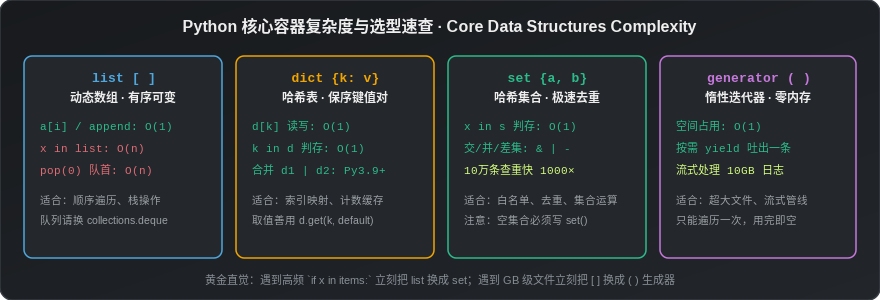
- 选对容器性能差 1000 倍:
list查重是O(n),set/dict是O(1)。 - 生成器(Generator) 让你用几 MB 内存优雅流式处理几十 GB 日志。
- Python 3.10+ 现代类型注解(
list[str]、str | None、@dataclass)让代码既像脚本一样快写,又像强类型语言一样好维护。
1. 变量不是“盒子”,是贴在对象上的“标签” / Variables Are References, Not Boxes
理解这一点能避开 80% 的 Python 诡异 Bug:变量赋值只是把标签贴到内存里的同一个对象上。
- 不可变对象(
int,str,tuple):修改会生成新对象,绝对安全。 - 可变对象(
list,dict,set):b = a后改b.append(1),a也会一起变!需要独立副本请用a.copy()或copy.deepcopy(a)。 - 头号经典大坑——永远不要把
[]或{}设为函数默认参数!默认参数只在函数定义时创建一次,所有调用会共享同一个列表。
In Python, assignment binds a name to an object rather than copying it. Mutating a shared list or dict mutates every reference to it. Never use mutable defaults like def add(x, buf=[]):—use None instead:
1 | # ❌ 经典大坑:多次调用会污染同一个列表 |
2. 推导式与生成器:把 10 行循环写得既短又快 / Comprehensions & Generators
Python 的列表/字典推导式不仅简洁,底层字节码还比手写 for + append 更快;当数据量巨大(如逐行读 10GB 文件)时,只需把方括号 [ ] 换成圆括号 ( ) 或用 yield,立刻变成惰性生成器(O(1) 内存):
Comprehensions are both cleaner and faster than manual append loops. Swap [...] for (...) or yield to stream multi-gigabyte files in constant O(1) memory:
1 | from pathlib import Path |
3. 现代类型注解 + @dataclass:告别“到处传裸字典” / Type Hints & Dataclasses
用 dict 传来传去(order["usr_id"] 拼错字母要跑到线上才炸)是大型 Python 项目腐烂的元凶。现代 Python 直接用 @dataclass(slots=True, frozen=True):
- 自动生成
__init__、__repr__、比较方法; slots=True省内存且防手误乱加属性;frozen=True不可变,防并发或跨函数意外篡改。
Passing raw untyped dictionaries everywhere causes silent key typos. Use @dataclass(slots=True, frozen=True) for fast, immutable, IDE-autocompleted domain models:
1 | from dataclasses import dataclass |
4. 延伸官方参考 / Official Docs
- 📘 Python Official Docs: Data Structures & Typing
- 📏 PEP 8 & Ruff: Ruff — Ultra-fast Python Linter & Formatter — Rust 编写,1 秒替代 flake8 + black + isort。