Home
/
Columns
/
Python AI 实践专栏
🧠 PYTHON + AI
PAI-01
⏱ 8 min
📅 2026-11-27
Python 调用大模型实战:统一 SDK、流式输出、结构化 JSON 与重试容错
Calling LLMs in Python: Unified SDK, Streaming, Pydantic Structured Outputs & Retries
#Python AI
#Structured Outputs
#Streaming
#OpenAI SDK
🌐 阅读模式 / View Mode:
中英对照 Bilingual
仅中文 ZH
English Only
📑 目录 / Table of Contents
🔑 生产第一原则 / Production First Rule
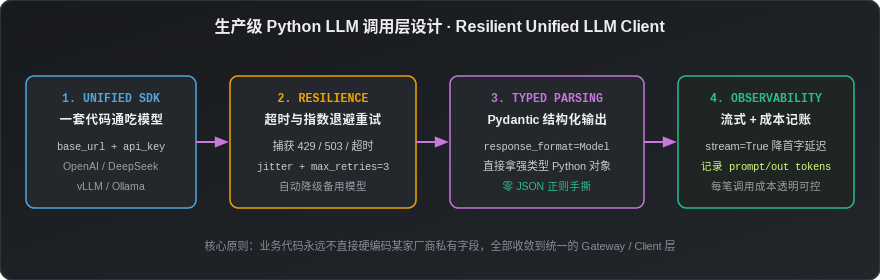
把模型地址(base_url)、密钥与模型名全收进环境变量——同一份 Python 代码只需改 3 行 .env,就能在 OpenAI、DeepSeek、Qwen、本地 Ollama、自建 vLLM 之间零改动无缝切换。
中文 告别 json.loads() 动不动报错的日子!直接把 Pydantic 模型传给 client.beta.chat.completions.parse(或兼容端点的 response_format),拿回来就是经过严格字段校验的 Python 对象:
EN Skip brittle regex JSON parsing—pass a Pydantic schema directly to receive a validated, typed Python object:
1 2 3 4 5 6 7 8 9 10 11 12 13 14 15 16 17 18 19 20 21 22 23 24 25 26 27 28 29 30 import osfrom typing import Literalfrom openai import OpenAIfrom pydantic import BaseModel, Fieldclient = OpenAI( api_key=os.environ["LLM_API_KEY" ], base_url=os.getenv("LLM_BASE_URL" , "https://api.openai.com/v1" ), timeout=30.0 , max_retries=3 , ) class TicketTriage (BaseModel) : reasoning: str = Field(description="先简要分析用户问题,再给分类" ) category: Literal["billing" , "bug" , "feature" , "other" ] severity: Literal["P0" , "P1" , "P2" ] reply_draft: str def triage_ticket (user_text: str) -> TicketTriage: resp = client.beta.chat.completions.parse( model=os.getenv("LLM_MODEL" , "gpt-4o-mini" ), temperature=0.0 , messages=[ {"role" : "system" , "content" : "你是工单分诊助手,严格依据原文分类,禁止臆测。" }, {"role" : "user" , "content" : user_text}, ], response_format=TicketTriage, ) return resp.choices[0 ].message.parsed
2. 流式输出(Streaming)+ 精准统计 Token 费用 / Streaming & Usage Tracking 中文 面向终端用户的对话产品,一定要开 stream=True ——模型生成全文可能需要 8 秒,但开流式后 0.4 秒就吐出第一个字,体感速度瞬间提升 10 倍;加上 stream_options={"include_usage": True} 还能在最后一片拿到精准 Token 统计用于成本记账:
EN Always enable stream=True for interactive UIs to slash perceived latency, and set stream_options={"include_usage": True} to record exact token costs on the final chunk:
1
2
3
4
5
6
7
8
9
10
11
12
13
14
15
16
17
18
19
20
21
22
def stream_chat (prompt: str) -> tuple[str, dict]: chunks: list[str] = [] usage_info: dict = {} stream = client.chat.completions.create( model=os.getenv("LLM_MODEL" , "gpt-4o-mini" ), messages=[{"role" : "user" , "content" : prompt}], stream=True , stream_options={"include_usage" : True }, ) for event in stream: if event.choices and event.choices[0 ].delta.content: token = event.choices[0 ].delta.content print(token, end="" , flush=True ) chunks.append(token) if getattr(event, "usage" , None ): usage_info = { "prompt_tokens" : event.usage.prompt_tokens, "completion_tokens" : event.usage.completion_tokens, } print() return "" .join(chunks), usage_info
3. 异步高并发批处理:百条数据几秒跑完 / High-Throughput Async Batching 中文 清洗或标注 500 条数据时,换用 AsyncOpenAI + asyncio.Semaphore(10) 并发限流,比同步 for 循环快 10 倍 且绝不触发接口限频。完整 asyncio 限流写法可回看 PY-02 并发实战 。
EN When processing hundreds of items offline, switch to AsyncOpenAI combined with asyncio.Semaphore(10) (see PY-02 ) for 10× throughput without hitting rate limits.
4. 权威参考 / References