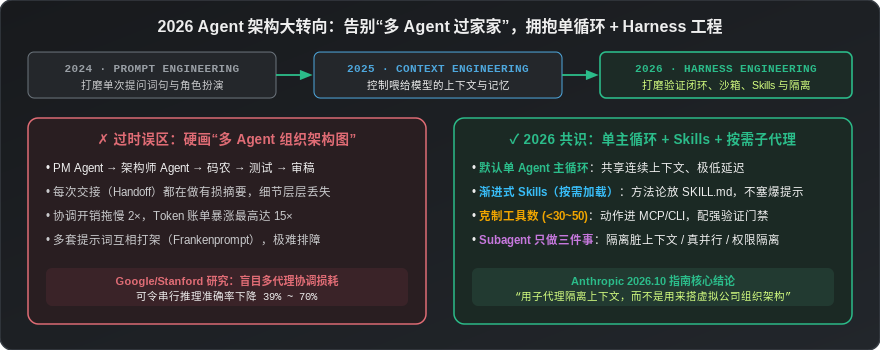
风向确实大变了,但不是“禁止用多 Agent”,而是彻底告别 2024–2025 年那种“给每个角色建一个 Agent 互相聊天”的过家家架构!
2026 下半年的行业铁律变成了两句话:
- 默认「单 Agent 主循环 + 渐进式 Skills + 精简工具」优先;
- 派 Subagent(子代理)的唯一正当理由是「隔离上下文噪声 / 真正并行 / 权限隔离」,而不是按人类部门画组织架构图。
1. 为什么 2026 年大家开始“给多 Agent 降温”? / Why the Industry Cooled on Multi-Agent Org Charts
2024–2025 年,全网教程都在画酷炫的“AI 虚拟公司”:一个产品经理 Agent 写完文档丢给架构师 Agent,再丢给前端/后端 Agent,最后丢给测试 Agent——图画得极好看,一进生产就翻车:
- 交接失真(Lossy Handoff):每多一层 Agent 转手,中间推理细节就要被压缩成摘要,传三手后彻底跑偏。
- 性能不升反降:Google 与 Stanford 的实证研究指出,盲目引入多 Agent 协调层会让串行复杂推理表现暴跌 39% ~ 70%,Token 消耗却可能飙升至单 Agent 的 ~15 倍!
- 模型变强了,旧胶水成了累赘:2026 年的新一代前沿模型已能在一个连续上下文里自己完成规划、调用工具与修正路线。Anthropic 在 2026 年 10 月发布的重磅实战指南(When to fold subagents into your main agent loop)中披露:把冗余子代理折叠回单主循环后,有客户实测端到端运行速度直接快了 ~2 倍、语气与全局一致性大幅提升。
In 2024–2025, everyone drew elaborate “AI org charts” (PM Agent → Architect Agent → Coder Agent → QA Agent). In production, those chains failed hard:
- Lossy handoffs dropped crucial nuance at every agent boundary.
- Coordination tax: Studies from Stanford and Google showed multi-agent coordination overhead can cut sequential reasoning accuracy by 39%–70% while burning up to ~15× more tokens.
- Anthropic’s Oct 2026 guidance (When to fold subagents into your main agent loop) formalized the reversal: modern models can plan inside one continuous loop—folding unnecessary specialist subagents back into one loop made a real customer workflow ~2× faster with higher end-to-end quality.
2. 什么时候折叠成一个,什么时候必须派 Subagent? / Fold vs. Keep: The 2026 Decision Matrix
| 判断维度 Dimension | ✅ 用「单 Agent + Skills」更好 | ✅ 必须派「Subagent 子代理」 |
|---|---|---|
| 上下文干净度 | 任务连贯,单窗口远未爆满 | 重度搜索/读几十个文件/翻长日志:把脏噪声关在子代理里,只吐干净结论回主窗口 |
| 任务依赖关系 | 串行推理(下一步强依赖上一步细节) | 真正独立并行:同时调研 3 个方案、同时改 2 个互不耦合模块 |
| 权限与安全隔离 | 同一套仓库读写权限即可完成 | 独立对抗审查 / 权限隔离:如只读 Reviewer(看不到草稿思维链)或隔离凭据的沙箱执行者 |
| 工作流复杂度 | 只是“步骤规范不同”(如周报 vs 发版)→ 写成 Skill 即可 | 单一提示词下工具/规则严重冲突,且 Eval 实测证明拆开后分数明显更高 |
3. 2026 必掌握的 4 大前沿实战技巧 / 4 Frontier Techniques Every Power User Uses in 2026
技巧 1:从 Prompt / Context 进化到 Harness Engineering(护栏与环境工程)
OpenAI(2026.02《Harness Engineering》)与 Martin Fowler(2026.04)共同定义了 2026 最核心的工程概念:决定 Agent 上限的往往不是换个更贵的模型,而是你给它搭的「执行套具(Harness)」!
最震撼的真实案例:2026 年 3 月,LangChain 团队一字未改底层模型,仅靠优化 Harness(更好的目录感知、确定性测试自检循环、上下文压缩与错误回流),就让自家 Coding Agent 在 Terminal Bench 2.0 榜单上从第 30 名一路杀进第 5 名!
个人立刻可落地的 Harness 改造:
- 把项目里所有隐性知识变成机器可执行脚本(
make check/npm run verify),让 Agent 每次改动必跑。 - 写好 Hooks(如文件保存后自动跑 Formatter / 类型检查),把机械规范从 Prompt 里彻底卸载给确定性工具。
Popularized in 2026 by OpenAI and Martin Fowler, Harness Engineering shifts focus from tweaking wording to engineering the agent’s execution environment. In March 2026, LangChain jumped from #30 to #5 on Terminal Bench 2.0 without changing the underlying LLM—purely by improving their harness (verification loops, context hygiene, and tool ergonomics).
技巧 2:渐进式披露(Progressive Disclosure)——Skills 与 Tools 严格分层
别再把 100 个工具和 5000 字规矩一股脑塞进启动提示词!Anthropic 实测发现:单次暴露超过 30~50 个工具定义时,模型选工具的准确率会明显断崖下跌。
2026 最优雅的解法是渐进式披露(Progressive Disclosure):
- Skills(
SKILL.md)= 怎么干活(方法论、步骤、审美标准、避坑清单):平时只放 1 句简短摘要在上下文,只有真正命中场景时才按需全文加载(Anthropic 靠这一招把 Claude Code 基础系统提示词削减了 80% 以上!)。 - Tools / MCP = 能干什么(原子动作、查数据、写文件、调外部 API):按意图精简分组,工具报错信息要写得像“给同事的排障提示”,让模型看一眼就知道怎么自纠。
Never dump 80 tools and 5,000 words of procedures into the initial prompt—tool accuracy degrades past ~30–50 active tools. Instead, split cleanly with Progressive Disclosure:
- Skills hold procedural know-how and load only on demand (letting Anthropic trim >80% of Claude Code’s base system prompt).
- Tools / MCP expose lean, intent-grouped actions with self-explanatory error messages.
技巧 3:开工前先让 Agent “反向拷问你”(Interview-Before-Plan)
面对模糊的大需求,2026 顶级玩家不再急着让 Agent 直接写代码,而是先触发反向访谈(例如在 Antigravity 里直接敲 /grill-me,或在 Claude Code/Codex 里说 “先向我提 3~5 个最关键的澄清问题并给推荐选项,对齐后再出方案”)。
花 90 秒回答 4 个精准问题,就能提前消除 90% 的架构返工——比改完 20 个文件再推倒重来快 10 倍!
For ambiguous projects, have the agent interview you first (e.g., /grill-me in Antigravity or asking Claude Code/Codex for 3–5 clarifying questions with recommended defaults) before writing a single line of code. Ninety seconds of alignment prevents hours of rework.
技巧 4:无头脚本化(Headless CLI)+ 定时/异步自治
不要只把 Agent 留在交互聊天窗口里——2026 的前沿用法是把 agy -p / claude -p / codex exec 直接嵌进 Git Hook、CI 流水线或定时任务(如 Antigravity 的 /schedule):
- 每日自动扫描依赖漏洞 / 汇总 PR 变更写 Changelog;
- 每次提 PR 自动跑独立 Reviewer Agent 做安全与边界审查;
- 遇到 CI 红灯自动拉日志、复现单测、开 Draft Fix PR 等你早上醒来一键审批合并!
Move beyond interactive chat: embed headless commands (agy -p, claude -p, codex exec) or /schedule into CI/CD and cron loops for automated PR security reviews, dependency audits, changelog drafts, and overnight bug-fix PRs ready for morning review.
4. 一手权威信源 / Frontier References
- 📄 OpenAI Engineering (Feb 2026): Harness engineering: leveraging Codex in an agent-first world
- 🏛️ Martin Fowler (Apr 2026): Harness engineering for coding agent users
- 🧠 Single vs. Multi-Agent (Oct 2026 Analysis of Anthropic’s Guidance): Single agent vs multi-agent: when subagents are worth it
- 🎯 Context Isolation Essay (Nov 2026): Subagents: isolate context, don’t build an agent team
光看不练假把式!前往全新双轨专栏 🛠️ Agent 实战项目工坊,亲手用这 4 项 2026 前沿技巧完成 3 大硬核实战项目(老手走 ⚡ 3 篇速通版,基础读者走 🧱 9 篇分步手把手连载)。